
The PRS Dragon 2002 Review: Is it really worth the money? What's it actually like to play? Find out about guitar investment and PRS guitars!
Paul Reed Smith Dragon 2002 Review
Some in depth info about the Dragon 2002 from Paul Reed Smith. PRS did set a precedence of what is really a top end guitar with incredible inlay work as opposed to just a high end guitar. Remember back in 2002 PRS along with the company that actually does all the slick inlay work for all PRS guitars ( Pearl Works) no matter what model of the week PRS calls them used computer driven equipment so they could nigh on produce anything, just like China does these days!
The fact is, that the inlay itself is amazingly impressive in real life, take a look:
 |
Of course, there are many companies that could achieve this, but how many actually did? and at what price? This sort of work involves much more than just a bit of technology and simply sticking the inlay on a guitar. The guitar itself, is (in my opinion) based along very similar lines to a Gibson Les Paul and frankly, in a dark room it would be difficult to tell the difference between this model and a real Les Paul, no matter what some lawyer said. That's plain and simple ordinary guy common sense.
What materials did they use for the inlay?
As you can imagine, there is a massive array of different natural products that go in to making inlays of this level. On the Dragon series of guitars from PRS that's always been the case, topping well over 430 pieces (if I remember correctly on the Dragon III). But, while the PRS Dragon 2002 has less pieces than that intricate neck of the Dragon III, it is no less impressive, in fact quite the contrary. Materials used include abalone shells of one type or another, other shell, coral, turquoise, gold, mammoth Ivory and much more. Just getting this stuff together in the first place was probably a nightmare; and one which ultimately will increase the cost of the guitar to make.
Anything Else Special?
Well, actually yes there is. The neck is made from Brazilian Rosewood (which has to be old to ensure no law is being broken), and those pickups fitted are the No #7 pickups which are not too common either.
Turning to the Brazilian rosewood first:
Importers in the USA have to go through grueling paperwork, inspection, more paperwork, more inspections, wood testing, a CITES Export permit is then granted so the wood can be shipped. The there's further inspection and paperwork by US Customs and Border Protection, USDA, and the Department of Homeland Security, upon entry in the US, to make sure the shipment IS legitimate. A legitimate shipment of Brazilian rosewood requires 3 permits, 1 declaration, and strict, complicated, lengthy legal procedures. If you want to re export a guitar with Brazilian rosewood on it? It can be done, but only when the correct procedures and paperwork are there. Most Brazilian rosewood is legal, properly permitted, with paperwork to back it up. If you purchase Brazilian rosewood without the necessary proof of legality for the USA there is no way to export the guitar. Strange how PRS marks guitars with confirmed Brazilian rosewood as USA market only?
The price of solid Brazilian rosewood fingerboard/fret boards and necks can be astronomical compared to illegally imported Brazilian rosewood so often the cheapest could be highly questionable regarding the source and legality of the wood. Typical price fluctuates but for a simple fret board overlay it can easily cost $200 simply for a thin fret board slither of Brazilian Rosewood in it's original state; imagine what a whole neck would cost?

Brazilian rosewood neck; click for large view
As you just might see from the headstock end of this neck, it was joined by another piece of Brazilian rosewood and in fact was joined again at the top of the headstock. This was probably because the consignment that PRS had was actually too short for the neck length required. And it's not unique to this #6 (of the 100 run) either - I have seen this on all other ones I have had the privilege to examine - including prototypes and even Carlos Santana's own Dragon 2002 No #53 as shown below:
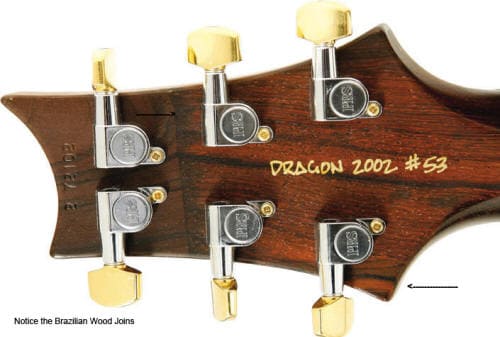
Santana's Dragon 2002; Notice the join of the Brazilian rosewood 3/4 of the way up the headstock; click for larger view
Now what about those No #7 PRS pickups?

PRS pickup specifications; click for larger view
As you can see the PRS #7 pickups are high output, but not that high compared to many of the pickups that PRS has made over the years; the Tremonti treble pickup having a 15.42 DC resistance measurement while the #7 treble has just 8.44 DC resistance so the Tremonti has substantially more output. Often the #7 is compared to the 57/08 pickup and from the table above you can see that the 57/08's have indeed a lower output. I guess more in keeping with a 1957 pickup. While the #7 is not unique in the pickup world, it seems to be on this style of guitar from PRS. No doubt someone will know better than me but that's ok.
Remember that DC resistance is not really a measure of the output of a pickup but it does give a pointer in that direction as clearly if you have played them, the Tremonti pickup has more output than the #7 from PRS. I would describe the sound of this pickup through a Road King II on channel 3 vintage, just hitting one E chord as like the sound of a growling dragon! yes really as you will get to hear on the videos.
Anything Else that Stands Out on this Guitar?
Sure is.
As many guys will know Gibson Les Paul guitars without being hacked inside (chambered) can weigh a ton. Well, along with the design that Paul took (shall we say emulated?) he gained the weight factor too; no I don't mean he needs to get on a diet, I mean that the Dragon 2002 is absolutely not chambered and you can tell the second you pick one up (if you ever get a chance to). The Dragon 2002 is heavy. There's no pussy footing around, its a solid piece of mahogany used for the back; and there's that extra weight for the Brazilian Rosewood stuck on for the neck. Add to that a nice piece of maple (which is also likely heavy) and those inlays and you have one heavy mother; or should that be dragon? Whatever you want to call it, trust me on this it's heavy.
Maybe, one reason Carlos was selling his #53; as you get older it's hard to have one of these strapped around your neck for hours on end and there's only so much your body will take before you get effectively a nice (and painful) drooping shoulder which then goes on to stop you playing later. So it's a serious subject which should not be overlooked. Why PRS didn't chamber this guitar I really cannot understand. Maybe someone should tell Paul that the Gibson Les Paul is chambered; and then I'm sure he will follow Gibson's lead.
So what's that PRS Dragon Inlay Really Like?

PRS dragons teeth; click for large view
Examine those mammoth tusk teeth and you will see that they appear to be finely engraved to give them a sort of 3D look. In real life they are sharp enough to jab in to your fingers (only kidding but they really do look that way).

Click the image for larger view
Notice that the body on the Dragon 2002 is curved like a Gibson Les Paul. Now imagine you have these hundreds of bits to stick on the top of the guitar; difficult? you're right it's difficult. So here's what PRS and Pearl Works came up with; hack off the surface of the guitar to take the design (use a fine router), fit the dragons head to the guitar (with glue on there) and then put the body in to a plastic bag. Now remove all of the air and create a vacuum, so that effectively external air pressure holds the dragon inlay parts in place while they set. Hmmm sounds to me Paul wants to make some carbon fiber? Well not really but the procedure is similar in many ways.
As one meerkat said 'simples'.
OK now we have the Dragon's head on the guitar. Its now a matter of sanding the finish, doing some work on things like the teeth (which to me look like they have had some engraving work with colour added to make that 3D view look real) and other parts, and then I would hazard finishing of the guitar with a lacquer as PRS does indeed do to most guitars they make. Well what's the upshot of all of this?
It's the PRICE of the guitar to the end user! You, if you are lucky enough to own one at any time. That price to make the guitar was probably as high as retail; 40% (dealer margin); 40% PRS down to actual cost; which might well have been somewhere around $10,800 or maybe even lower. As a manufacturing cost thats pretty high. Now that's just my guess remember but if my guess is anywhere near that then you can see how easily the retail price shoots up. Typically you could buy these in the day for around $20,000 to $24,000 but thats still a high price by anyones standard. Dealers did discount no matter what they claim.
How much was the Dragon 2002?
Well back in the day (I just love saying that) this guitar had a retail figure of $30,000 and you can bet that by the time it got here in the UK it would have cost £30,000 or somewhere very near. Indeed even today there are Dragon 2002's out there fetching € 30,000 (that's about £25,000 July 2015). Now that one I saw was a prototype (big deal not) but let's be serious for a moment, the Dragon 2002 was not worth $30,000 in 2002, and it's not worth £25,000 today! Current prices are so variable. The guys who want the earth for them (think € 30,000) will be with them for some time. The more realistically priced ones in 2015 can go from $12,000 to $15,000 typically but that figure has been reducing. In the UK? Think $ equals £'s!
The Urban Myth of Investment in Guitars - Exposed
I want to talk a short while about PRS (and other) guitars bought as an investment. There are many wealthy guys out there that have bought guitars simply to put money in to on the basis that they will go up in price so they can later sell them and make a profit. And there's nothing wrong with that bearing in mind the state of the banks; is your money even safe? I guess at least if it's under the bed (metaphorically speaking) then it's safer than in some bankers coffers right?
But hold on a minute; these investor guys have been on the 'Dragon' thing since the Dragon 1 appeared in 1993? That's true, and you know what? most of those investors have lost money today against their original purchase price. I don't think that there is a single Dragon model from PRS that has increased in value over recent times. In fact, most of them have fallen dramatically in price that others will pay for them. It's true they did climb up, but today, the same marketplace is in a sorry state of affairs where guitar investments typically lose money. Bigtime!
That's not just limited to PRS either, it's a fact that the guitar market for investment has become extremely fraught with issues when it comes to making money. There are some models which have hovered around the same price for some time, and a very elite few that have increased in value, but the majority of these collector guitars frankly have devalued, so maybe it's not a good idea to invest in guitars in this way right now. Of course you could take the alternative view, NOW is exactly the right time to invest in the guitars; if you buy them cheap (as you can now) then maybe the only way is up (over time of course).
In the case of PRS and their recent 'collector' series that may be one extra line for PRS to crowbar more money from it's devoted fans, but is it seriously 'better' than the 'Private Stock' that must have run out of Pauls 'stashed' wood by now. I noticed that they are also removing some options from the 'Private Stock' stuff and making it exclusive to the 'collectors' models so if you want those features you have little option but to buy the more expensive guitars. Seems that those 'Private Stock' guitars are not all that PRS really made them out to be in the first place (at least money wise). In my opinion that new 'collector' series of guitars from PRS has actually devalued the 'Private Stock' stuff somewhat. Ouch. So I would say all things considered that if you buy a guitar today from PRS (or other company) on the basis of an investment then don't do it!
So Why Did YOU Buy a Dragon 2002?
I hate to say this, but since I first saw one of these I wanted to buy one; but I simply did not want to put that money in to it at the time. There is no way that I would pay $30,000 for any guitar or the British pound equivalent. But you own one? You're right I do. However I bought this guitar at the right price for me so I can play it! And so I have a piece of history as far as PRS is concerned. Indeed I have bought a Dragon III and never play it simply because it has never been played from new. That's OK for that guitar and I would feel guilty playing it, so I guess that guitar is a collectors piece (I really don't know of any other Dragon III which has not been played from new). But I did buy that one a while ago and it was for the investment thing; so I lost money on it, just as you would.
This Dragon 2002 IS for playing and I have uploaded a video of it below:
And here's a video review of the Dragon 2002 that I completed some time ago:
This is the Video review on my channel on YouTube: www.youtube.com/tonymckenziecom (note no dot before the 'com')
So what's the review conclusion?
Actually for a guitar costing as much as many of these do there are some plus points and some negatives (which could prove to be bad) as follows:
The good points include:
- Awesome Dragon on the guitar
- Limited to just 100 guitars plus a few prototypes
- Solid Brazilian rosewood Neck
- Les Paul Design and Vibe
- Great Sound
- Great Playability
- Nice Case
- Stop/Tail Bridge
And the less good points include:
- Very heavy guitar
- Terribly high price when new
- Bad investment (as most PRS are)
- Easily stolen
- Utmost care needed while playing it
Actually I really like the PRS Dragon 2002, but I liked most of the other Dragon's too (after all I married one); I would relate this guitar to someone who wants the ultimate Les Paul that Gibson don't make; it's for someone who wants an awesome looking guitar with such great stuff as Brazilian rosewood on the solid neck in a big way; but most of all if you play guitar and like how great the Dragon 2002 looks and you get the chance to get one then buy it.
The sound to me is very different than a Gibson, the playability is awesome (but so are many Gibson Les Pauls) and not really like any other PRS I have ever played. Even just opening that case will make you take a deep breath of air at the guitars beauty; the Dragon 2002 is incredible of that there is no doubt. As a score or rating out of 10? This unique electric guitar scores a 9.
The reason is simple its that weight. If Paul Smith had just chambered these things you would have a very playable world leading guitar, as opposed to a world leading guitar and there IS a difference just trust me on this. Lastly, watch the video above showing the sounds of this guitar, but to finish off this review below are a few other shots I took of the guitar.
I really hope you liked the review of the Dragon 2002 from PRS but remember that this work remains my copyright.
HHere's the pictures:

Click any image for larger view


Thank you for taking the time to read this review.
© A B Mckenzie 1997-2026. All Rights Reserved